Farmer Grey
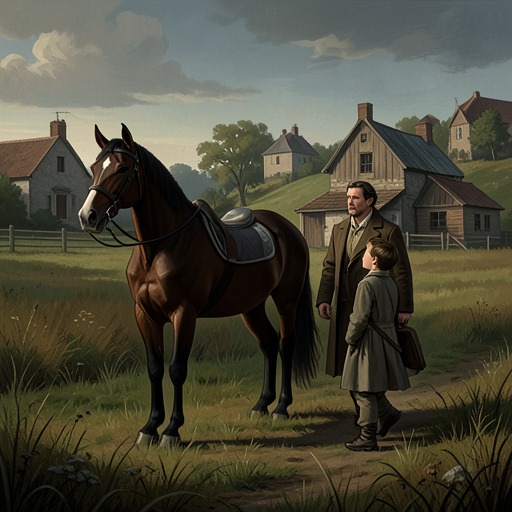
Black BeautyFarmer Grey is the humane early master remembered by Black Beauty, and the owner of Duchess, mother of Black Beauty and Rob Roy. His care shapes the horse’s first experience of human handling, while his long campaign with Squire Gordon against check-reins gives him a wider role in the book’s argument for considerate treatment of working horses.
Identity and Early Home
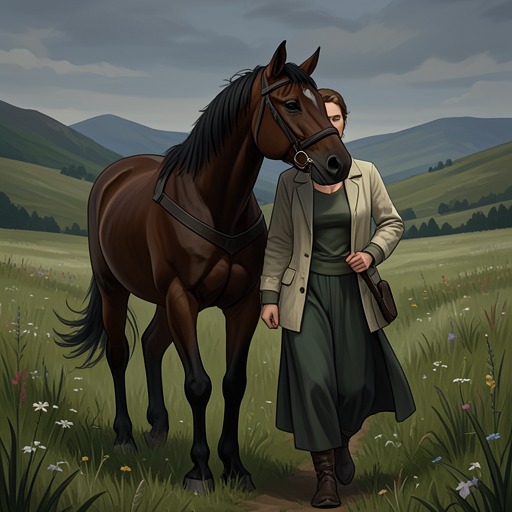
Black Beauty’s earliest remembered world is a large meadow with a clear pond, shady trees, rushes and water-lilies, a fir grove, and a running brook beneath a steep bank. His mother stays close while he is young, and, once he can eat grass, she goes out to work by day and returns in the evening. The account establishes the sheltered setting of his early life before he enters more demanding work.
Farmer Grey is identified through the horses in his care: his old mare Duchess is the mother of both Black Beauty and Rob Roy. Black Beauty learns this only later, when John Manly explains their kinship. Rob Roy has already been killed in a hunt, and the revelation helps Black Beauty understand why his mother had been so troubled by that loss.
Care and Breaking-In
Farmer Grey does not put Black Beauty to work while he is still growing. He waits until the colt is four, explaining that colts should not work like horses until they are fully grown. When Squire Gordon comes to examine the young horse, Farmer Grey agrees to break him in himself because he does not want him frightened or hurt.
The breaking-in introduces Black Beauty to the bit and bridle and, more broadly, to the equipment and obedience expected of a working horse. Farmer Grey uses oats, coaxing, pats, kind words, and gentle handling to help him accept the bit. The contrast between the horse’s discomfort with unfamiliar equipment and the patience of the person introducing it makes Farmer Grey’s method concrete: care does not remove the demands of training, but it changes how those demands are imposed.
Kinship and Relationship to Black Beauty
Farmer Grey’s household is the setting for Black Beauty’s earliest remembered life, but the horse’s understanding of that period changes as he learns who his family was. John Manly identifies Duchess as the mother of Black Beauty and Rob Roy. Black Beauty had not known that Rob Roy was his brother; the discovery connects his own history to the earlier hunt and to Duchess’s grief.
Black Beauty later names Farmer Grey alongside Squire Gordon as one of the good masters whose treatment had taught him that humane handling was possible. The recollection is not merely an endorsement of an individual: it supplies a standard against which the narrator can measure fear, punishment, and neglect elsewhere in his life.
Animal Welfare and Public Action
Farmer Grey’s concern extends beyond the horses under his own care. He and Squire Gordon have worked together for more than twenty years to get check-reins removed from cart-horses, and Black Beauty notes that the devices are seldom seen in their district. Their sustained effort links private kindness to a public attempt to change a harmful practice.
The novel presents Farmer Grey as part of a wider ethic of responsibility: patient training at home and persistent opposition to needless restraint belong to the same principle. His influence is clearest in the contrast Black Beauty draws between masters who understand a horse’s fear and those who answer it with force. In the horse’s life story, Farmer Grey stands at the humane beginning—and remains a measure of what responsible treatment can be.